
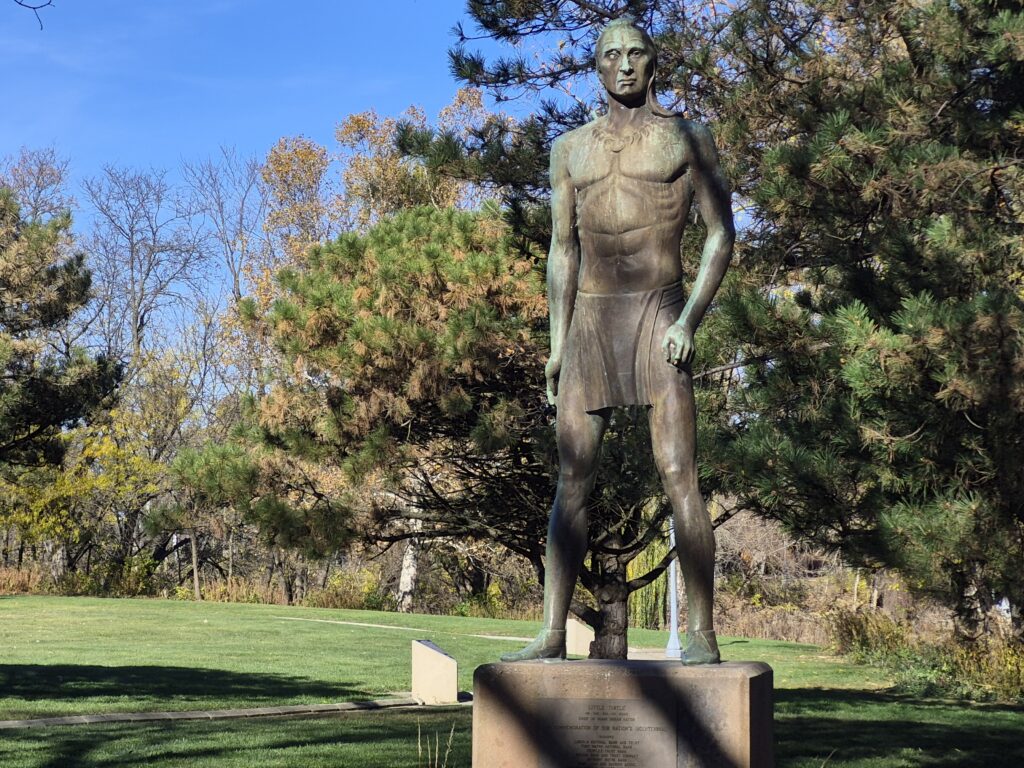
Known to history as Little Turtle, Mihšihkinaahkwa was a prominent Myaamia leader whose life joined the story of Kekionga—today’s Fort Wayne—to the wider struggle over Native sovereignty in the Ohio Valley and Great Lakes. He became famous for military victories, but he was also a diplomat who worked to protect his people through a period of relentless U.S. expansion.
In November 1791, an American army led by territorial governor Arthur St. Clair marched toward Myaamia towns in the Ohio country. A multi-nation force met it near the Wabash River and won a stunning victory. The defeat—remembered as St. Clair’s Defeat—was among the worst ever suffered by the U.S. Army against Native forces. One of the leaders associated with that victory was Mihšihkinaahkwa, known in English as Little Turtle.
That battle made his name famous among Americans. For the Myaamia, his importance was broader: he was a leader whose responsibilities included defending communities, speaking in councils, and deciding how to respond to a powerful neighboring government that kept pressing for Native land.
A Myaamia leader from the Kekionga region
Mihšihkinaahkwa’s name is often spelled in older English records as Meshekinnoquah or in other variations. The familiar translation is “Little Turtle.” Myaamia community writer George Ironstrack gives his birth as approximately 1747, while other historical references place it closer to 1752. The details of his childhood and exact birthplace are not firmly established. He grew up in the region between the upper Maumee and Eel River watersheds, in the homeland of the Myaamia people.
Kekionga, the major Myaamia village at the confluence of the St. Joseph and St. Marys rivers, was a central place in his life and in the history of the region. In 1780, when a force led by Augustin de La Balme attacked the village, Mihšihkinaahkwa helped lead the counterattack. The episode marked his emergence as a military leader during a conflict that would continue for years.
War in the Ohio country
In 1790, Little Turtle helped organize resistance to General Josiah Harmar’s expedition against Kekionga and surrounding Native towns. The U.S. troops burned villages and supplies, but a counterattack inflicted a serious defeat. The following year, a larger American force under St. Clair advanced into the region. Native warriors from several nations defeated it near the Wabash.
These were not simply contests between two armies. The Native alliance included Myaamia, Shawnee, Lenape, Odawa, Potawatomi, and other communities defending their homelands against U.S. expansion. Little Turtle was a prominent Myaamia war leader within that broader alliance; he should not be treated as the sole commander or representative of every nation involved.
In 1794, General Anthony Wayne’s forces defeated the confederated Native alliance at the Battle of Fallen Timbers. Myaamia accounts describe Little Turtle as favoring peace before the battle, but he could not persuade the wider community to stop fighting at that point. His son-in-law, William Wells, had returned from U.S. territory with information about the strength of Wayne’s army. The defeat shifted the balance of power and brought the alliance to treaty negotiations.
Diplomacy after Greenville
At the Treaty of Greenville in 1795, Mihšihkinaahkwa served as a council speaker for the Myaamia. The treaty ended the Northwest Indian War, but it also required Native nations to cede a vast area, including much of present-day Ohio, to the United States. The agreement brought a pause in large-scale fighting; it did not end American pressure on Myaamia lands.
Little Turtle continued to pursue diplomacy. He traveled east to meet U.S. leaders, spoke against the destructive liquor trade, and sought Quaker assistance to teach new farming methods. These efforts were part of his work to sustain Myaamia communities under worsening conditions. They did not mean that he accepted the loss of Native sovereignty or approved every U.S. demand. Little Turtle and other Myaamia leaders continued to resist further land cessions, even as officials tried to divide Native communities and secure more territory.
His influence declined after the Treaty of Fort Wayne in 1809, when he argued that Delaware and Potawatomi leaders should be included in discussions over land that affected them. The dispute reflected the pressures facing Native diplomacy: U.S. commissioners pushed for cessions, while Indigenous leaders debated who had the authority to negotiate and how to protect their people’s remaining land.
Remembering Little Turtle
Mihšihkinaahkwa died near Fort Wayne on July 14, 1812. Within months, U.S. forces destroyed Myaamia villages in the region, including the village where he had lived. That aftermath makes the limits of diplomacy plain: even a leader who worked for peace could not prevent the continued invasion and destruction of his people’s homeland.
Today, Little Turtle is often remembered through the battles that made him famous. His story also belongs to the history of Kekionga and the Myaamia people, whose communities and political life long predated the city of Fort Wayne. Remembering Mihšihkinaahkwa means seeing both his strategic brilliance and the difficult choices he faced as he tried to defend his people in an era of mounting U.S. power.
Sources and further reading
- George Ironstrack, Myaamia community historian, “Mihšihkinaahkwa – A Brief Biography of ‘Little Turtle.’”
- Tom Castaldi, The History Center, “Meshekinnoquah (Little Turtle).”
- Supreme Court of Ohio, “Little Turtle (1752–July 1812).”
- Indiana Historical Society, “Little Turtle,” Notable Hoosiers.
- Harvey Lewis Carter, The Life and Times of Little Turtle: First Sagamore of the Wabash (Urbana: University of Illinois Press, 1987).