
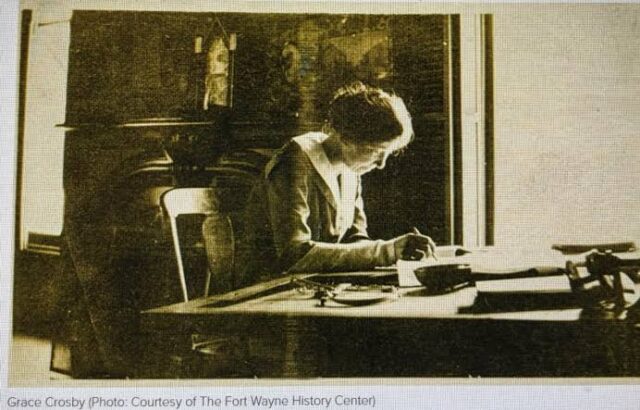
In the early twentieth century, Fort Wayne’s new neighborhoods filled with carefully planned homes: broad porches, practical rooms, generous windows, and details that made everyday life more comfortable. Behind many of those designs was Grace E. Crosby, a Fort Wayne native whose skill as a draftswoman and architectural designer helped shape the city’s residential landscape.
Crosby began working in architecture when the profession offered few formal paths for women. She learned through apprenticeship, built a career across several local firms, and became a key member of the design team at Wildwood Builders. Her story is a reminder that the familiar homes of Fort Wayne were created not only by celebrated names, but also by the skilled women whose drawings and design decisions made those buildings possible.
Learning the work in Fort Wayne
Grace E. Crosby was born in Fort Wayne in 1874 to George and Naomi Crosby. She graduated from Fort Wayne High School in 1891. Rather than attend a university architecture program, she trained in the local offices where buildings were planned and drawn. That apprenticeship route was common in the late nineteenth century, but it required patience, technical ability, and the chance to prove oneself in a field dominated by men.
By 1894, city directories listed Crosby as a “tracer” of architectural plans—a job that involved copying and preparing drawings. Around 1900, she was working as a draughtswoman for Fort Wayne architect Alfred Grindle. She remained with Grindle for about a decade, gaining practical experience in building design and construction documents. In the 1910 city directory, she was identified as an architect with Wildwood Builders, an important recognition of her professional standing in the city.
Designing with Wildwood Builders
Wildwood Builders was organized in 1910 by Fort Wayne attorney and developer Lee J. Ninde. His wife, Joel Roberts Ninde, designed houses, and Crosby joined as her design partner around 1909. The partnership brought together different strengths: Crosby’s long technical experience and command of architectural drawings with Ninde’s developing vision for attractive, practical homes. Their work helped make Wildwood Builders one of Fort Wayne’s most influential residential firms.
Crosby and Ninde’s designs appeared in Wildwood Magazine, a company publication distributed beyond Indiana. In 1912, Wildwood Builders published their plan book, Wildwood Homes: Being a Collection of Houses and Details with Suggestions for the Home Builder. It offered potential builders a range of designs and ideas for planning a house. Their homes favored considered room arrangements, ample light and ventilation, useful storage, and features such as sleeping porches that could extend a home’s living space.
Period accounts credited the Wildwood team with hundreds of houses by 1914. The surviving records do not clearly assign every plan to one designer, so Crosby’s contribution is best understood as part of a productive collaboration. Her work is associated with homes across Fort Wayne, including the South Wayne area and neighborhoods such as Shawnee Place, Wildwood Park, and Lafayette Place. The houses they helped create remain part of the city’s architectural character.
A practice of her own
After Joel Ninde died in 1916, Crosby continued at Wildwood Builders and briefly operated her own architectural office at 409 East Berry Street. The timing coincided with World War I, when some male architects left Fort Wayne for military or government work and demand for building design remained. Crosby’s independent practice was a notable achievement in a profession where women had few opportunities to establish their own firms.
She kept working in Fort Wayne after the war. In 1918 she was listed as a designer at Steele-Myers Department Store. The next year she became a draftswoman at the S.F. Bowser Company, where she designed gasoline pumps and filling stations. Her career crossed the boundary between architecture and industrial design, showing the range of work that depended on a skilled technical designer.
Crosby later worked for Griffith and Goodrich, where city directories variously identified her as a draftswoman or architect. She also worked with Leroy Bradley, whose firm became Bradley & Babcock. She retired in 1930 after more than thirty-five years in the architectural field. Indiana’s first architectural registration law had taken effect shortly before her retirement, making hers a career formed largely before women had regular access to formal professional credentials.
A legacy in the city’s neighborhoods
Grace Crosby lived much of her life in her family’s home at 413 West DeWald Street, remaining there until her death in 1962 at age eighty-eight. The house itself predated her career, but it connects her story to a particular Fort Wayne place and to the local community where she learned and practiced her profession.
Today, Crosby deserves recognition as more than a supporting name in the story of Wildwood Builders. She was an experienced architectural draftswoman, a designer, a business owner, and one of Indiana’s earliest women to build a long career in architecture. Her work helped give Fort Wayne neighborhoods their enduring domestic character. Every surviving home linked to her is evidence of a professional life spent translating ideas into places where people could live.
Sources and further reading
- ARCH Fort Wayne, “Grace E. Crosby.”
- Indiana Landmarks, “Two Fort Wayne Women Put Their Stamp on House Design.”
- National Register of Historic Places, “The Grace Crosby House,” registration form.
- City of Fort Wayne, Lafayette Place Historic District documentation.
- Sarah Allaback, The First American Women Architects (Urbana: University of Illinois Press, 2008), pp. 204–205.