
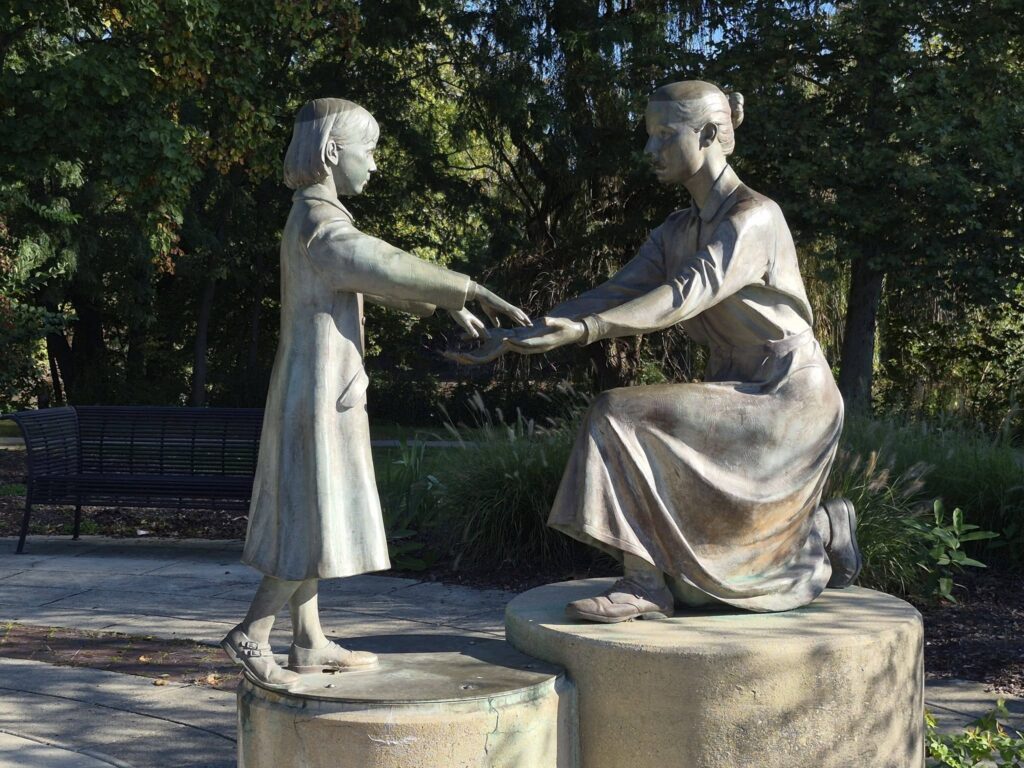
Agnes Hamilton (1868–1961) worked with women and families in Fort Wayne’s Nebraska neighborhood before devoting much of her life to the Lighthouse settlement in Philadelphia. Her story is one of hands-on service, local institution-building, and a quieter legacy within a well-known Fort Wayne family.
In Fort Wayne, the Hamilton name often brings to mind three cousins: Alice, the physician who investigated industrial disease; Edith, the writer who brought Greek literature to generations of readers; and Agnes, whose work began close to home. Agnes Hamilton helped organize Fort Wayne’s YWCA and supported young women who came to the city for factory work. Later, she made settlement work in Philadelphia her life’s central commitment.
Her contribution was less likely to make national headlines than her cousins’ achievements. It was also the kind of work that depended on steady presence: meeting people, finding practical ways to help, and keeping community institutions going over time.
Growing up in the Hamilton family
Agnes was born in 1868 into the extended Hamilton family of Fort Wayne. Her father, Andrew Holman Hamilton, was a son of Allen Hamilton, the early Fort Wayne merchant and public official. Her mother was Phoebe Ann Taber Hamilton. Agnes grew up on the family’s downtown compound among siblings, cousins, books, and the expectations that came with a prominent household.
Agnes and her sister Jessie shared artistic interests. After their father died, the two women were able to pursue formal art study at the Pennsylvania Academy of the Fine Arts in Philadelphia. But art was not the only calling that shaped Agnes. A church mission and the emerging settlement movement drew her toward the lives of working families in Fort Wayne and, eventually, Philadelphia.
The Nebraska neighborhood and the “Noon Rest”
In the 1890s, Fort Wayne’s factories depended on young women workers, many of whom had come to the city seeking employment. The Nebraska neighborhood near the Wayne Knitting Mills was one of the places where working women lived and worked. Through volunteer service in a church mission there, Agnes encountered the hardships they faced, including low wages, insecure housing, and limited places to find a meal or companionship.
Agnes became a leading organizer of the Fort Wayne YWCA. The organization first met at the Hamilton Homestead in 1894, with Agnes among its founders and its first president. She also took charge of a low-cost tea and lunch service known as the “Noon Rest,” located on West Wayne Street. A boarding house followed, offering room for young women who needed a safer and more dependable place to live. The YWCA connected these immediate needs with social, educational, and spiritual activities.
This was practical work in a city changing quickly. As manufacturing expanded, women arrived looking for jobs, and affordable housing did not keep pace. The YWCA’s meal service, rooming options, and social programs responded to that gap. Agnes’s efforts helped make an organization that could support women beyond a single act of charity or a short-lived mission.
From Fort Wayne to the Lighthouse
Agnes’s interest in settlement work took her beyond Indiana. In 1897 she made a brief visit to Hull House in Chicago, where her cousin Alice Hamilton was already involved. The settlement’s combination of community life, service, and social reform made a deep impression. Agnes returned to Fort Wayne, but a few years later she moved to Philadelphia with Jessie, where they continued their art studies.
In Philadelphia, Agnes joined the Lighthouse, a Presbyterian settlement in the Kensington neighborhood. By about 1901 she had moved into the settlement and made it her home. She became a director and served on its executive committee into the early 1930s. Unlike a visiting volunteer, Agnes was part of the institution’s daily life for many years. The historian Mina J. Carson describes her as one of the settlement movement’s committed “insiders,” whose loyalty to a particular neighborhood helped give the work continuity.
The Lighthouse represented a continuation of the religious and social service work Agnes had begun in Fort Wayne. Her life at the settlement combined ordinary routines with a broad commitment to the people it served. When Agnes and Jessie later left Philadelphia, Agnes’s long years there had already helped sustain the institution and its community.
A quieter Hamilton legacy
Agnes Hamilton died in 1961. Today, her name is often included alongside Alice and Edith’s, but her work deserves to be remembered on its own terms. She helped organize a local YWCA at a moment when young working women needed housing and support, and she spent decades building relationships and continuity at a Philadelphia settlement house.
Agnes’s story also widens our picture of Fort Wayne’s history. The city’s growth depended not only on prominent merchants, factory owners, and civic leaders, but on people who worked to make daily life more livable for those with fewer choices. Agnes Hamilton’s path from the Nebraska neighborhood to the Lighthouse shows how a local response to need could become a lifelong vocation.
Sources and further reading
- Mina J. Carson, “Agnes Hamilton of Fort Wayne: The Education of a Christian Settlement Worker,” Indiana Magazine of History.
- The History Center, “The Extraordinary Hamilton Family.”
- The History Center, “‘Industrial Girls,’ a Boomtown, and the YWCA.”
- YWCA Northeast Indiana, “History of YWCA Northeast Indiana.”
- Sue Slick, Fort Wayne Museum of Art, “What We’re Reading: The Fort Wayne Hamilton Family.”