Observed on Thanksgiving Day, the National Day of Mourning began in Plymouth, Massachusetts, as a gathering led by Indigenous people. In Fort Wayne, the day offers a reason to look closely at the history of Kekionga and at what United States expansion cost the Myaamia people.
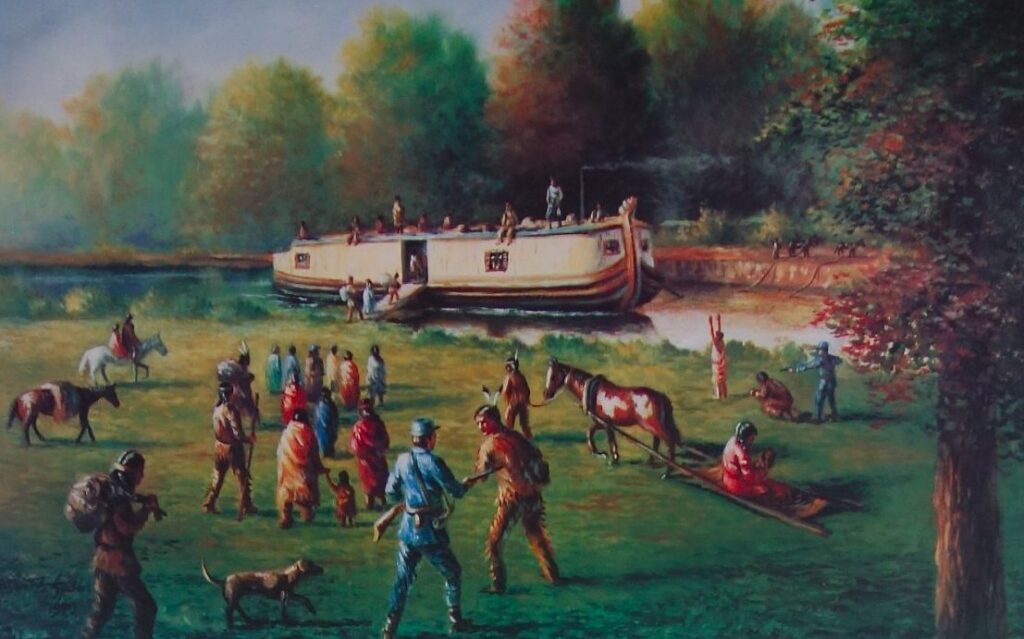
In October 1846, five canal boats carrying Myaamia people forced from their Indiana homes passed through Fort Wayne. A federal agent writing from the city said the departure had gone “peaceably and quietly.” In the same letter, he credited the military presence with making it happen. Myaamia historian Diane Hunter’s account begins with what families experienced before the boats ever moved. Soldiers had arrived at Peru, Indiana, and some Myaamia people fled north to seek refuge with the Pokagon Band of Potawatomi. Read together, these accounts show what the federal report’s language concealed. [1] [2]
Why the National Day of Mourning began
In 1970, Massachusetts officials invited Wamsutta Frank James, an Aquinnah Wampanoag elder, to speak at a banquet commemorating the 350th anniversary of the Pilgrims’ arrival. After reading his prepared remarks about what English colonization had meant for the Wampanoag, organizers would allow him to speak only if he delivered a replacement text. James refused. Indigenous people and supporters gathered in Plymouth that Thanksgiving for the first National Day of Mourning. United American Indians of New England continues to organize the observance at Cole’s Hill, where participants remember their ancestors and speak about Indigenous rights and struggles today. [3] [4]
The 1621 harvest gathering took place in the aftermath of devastating epidemics that had swept through Wampanoag communities, including Patuxet, where the English built Plymouth. The gathering belonged to a particular moment of diplomacy between the Wampanoag and the settlers. In the decades that followed, English settlement brought growing pressure on Wampanoag lands, war, and the enslavement of Native people. Across what became the United States, Indigenous nations faced different combinations of epidemic disease, dispossession, warfare, and forced migration. Their responses varied as well, from diplomacy and military alliances to rebuilding communities after removal. [3] [5]
Before Fort Wayne, there was Kekionga
At the confluence of the St. Joseph and St. Marys rivers, where they form the Maumee, stood Kekionga, a major Myaamia settlement. A nearby portage linked the Maumee watershed to the Wabash, connecting routes toward Lake Erie and the Mississippi River system. These routes sustained travel, trade, and diplomacy long before the United States established a fort here. The Myaamia, also known in English as the Miami, called this region home. [6] [7]
By the late eighteenth century, the United States was pressing into the Ohio Country. In 1790, troops under General Josiah Harmar burned villages in the Kekionga area, and Native forces counterattacked. The following year, a coalition of Native nations defeated General Arthur St. Clair’s army. Mihšihkinaahkwa, known as Little Turtle, was among the Myaamia leaders who helped defend the homeland. After General Anthony Wayne’s victory at Fallen Timbers in 1794, his army built a fort at the confluence. The 1795 Treaty of Greenville ceded much of present-day Ohio and specified a tract six miles square at or near Fort Wayne. The treaty thus gave the United States control of land at a river junction central to Myaamia life and regional travel. [6] [7]
From land cessions to forced removal
During the first half of the nineteenth century, federal officials pressed for more Myaamia land as American settlement expanded in Indiana. Successive treaties reduced the land the tribe held. The 1838 treaty ceded territory south of the Wabash and provided for land west of the Mississippi. The 1840 treaty ceded the tribe’s remaining commonly held Indiana lands and set terms for removal. Myaamia leaders negotiated for payments and land protections under mounting pressure. Some families secured exemptions that allowed them to remain in Indiana, while many others faced expulsion. [8] [9] [10]
On October 6, 1846, the forced journey began at Peru. The boats took families along the Wabash and Erie Canal through Fort Wayne, with transfers and an overland leg still ahead before they reached what is now eastern Kansas. The canal, often remembered for bringing trade and growth to Fort Wayne, also carried Myaamia families away from their homeland. Removal separated relatives, displaced families from familiar rivers and settlements, and forced people to rebuild under circumstances they had little power to choose. [1] [2] [8]
Kansas did not provide a lasting refuge. Beginning in 1873, a second removal took Myaamia families from Kansas to Indian Territory, in present-day Oklahoma. Families relocated over several years. The dispersal of Myaamia people across Indiana, Kansas, and Oklahoma reflects both the terms imposed on them and the different paths families took to preserve ties and sustain their communities. [1] [11]
A living people with a continuing connection to the homeland
Today the Miami Tribe of Oklahoma is headquartered in northeastern Oklahoma, and Myaamia people continue to live in Indiana and elsewhere. Through the Myaamia Center, a partnership between the Tribe and Miami University in Oxford, Ohio, Myaamia people are bringing their language, Myaamiaataweenki, into homes, youth programs, and classrooms. Family teaching, archival research, and tribal education have helped a new generation learn and use the language. [11]
The National Day of Mourning began with a Wampanoag elder insisting on telling his people’s history in his own words. Here in Fort Wayne, Myaamia accounts ask us to look again at familiar places. At the confluence, there was already a community with its own political and economic life before the U.S. Army built a fort. Along the canal, there were families being forced from their homes as well as goods being carried to market. Those histories belong in the story Fort Wayne tells about how it came to be.
Works Cited
- Myaamiaki Aancihsaaciki (annotated removal history and documents). Aacimohtaatiiyankwi, May 2022. Includes the Fort Wayne subagency letter of October 7, 1846.
- Hunter, Diane. “Forced From Our Homes.” Aacimohtaatiiyankwi, October 1, 2021.
- United American Indians of New England. “Historical Information.” Includes Moonanum James’s speech at the 2001 National Day of Mourning.
- United American Indians of New England. National Day of Mourning observance and information.
- Smithsonian National Museum of the American Indian. “Timeline.” Native Knowledge 360°, The “First Thanksgiving”.
- Ironstrack, George. “Mihšihkinaahkwa – A Brief Biography of ‘Little Turtle.’” Aacimohtaatiiyankwi, January 20, 2020.
- United States and signatory Native nations. Treaty of Greenville, August 3, 1795. United States Statutes at Large, vol. 7, pp. 49–54, especially art. III. Library of Congress.
- Miami University Libraries. “About.” Myaamia Removal digital exhibit.
- United States and Miami Tribe. Treaty with the Miami, November 28, 1840. In Charles J. Kappler, ed., Indian Affairs: Laws and Treaties, vol. 2. Oklahoma State University Libraries.
- Hunter, Diane. “Exempt From Removal.” Aacimohtaatiiyankwi, October 28, 2021.
- Smithsonian Folklife Festival. “Language Reclamation.” Youth and the Future of Culture, 2025.