In November 1903, a Fort Wayne Morning Journal Gazette reporter spoke with a Spy Run resident named Marshal Comincavish about what he had found on his property. Comincavish showed the reporter a box and two bushel baskets filled with human bones. Nearby, crews had just cut Anderson Avenue through the old Anderson orchard. The land on either side had been divided into building lots, and grading the new street had exposed numerous graves. [2, pp. 1–2]
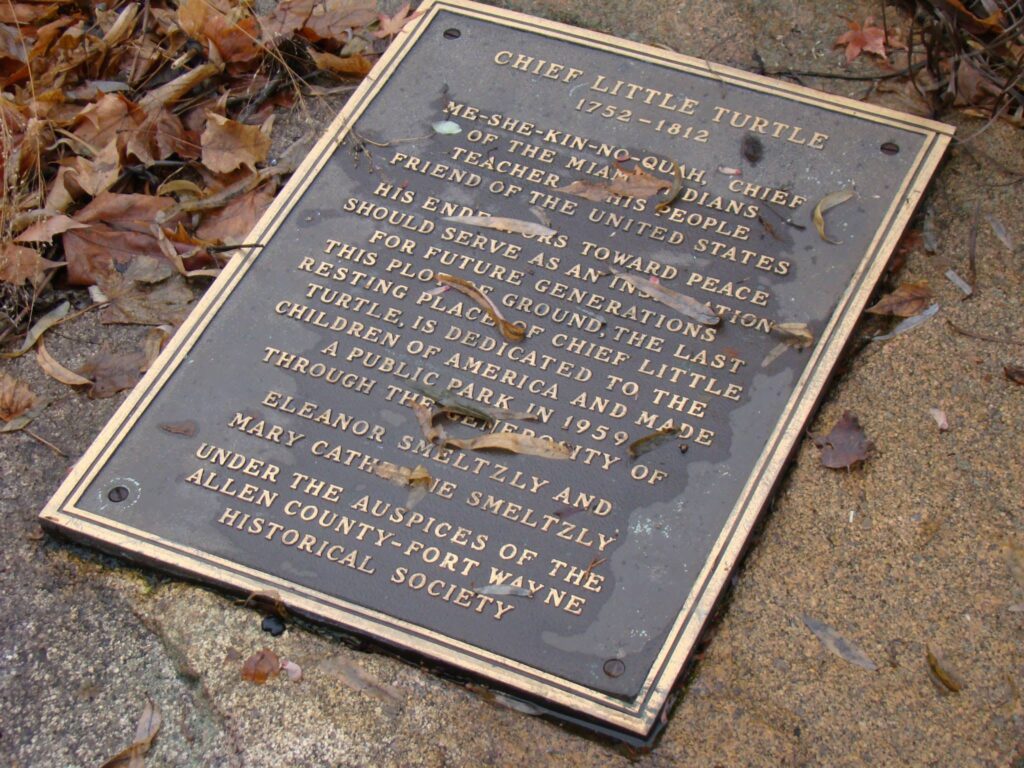
Today, Little Turtle Memorial Park on Lawton Place marks the burial of the Miami leader who died in 1812. The graves uncovered during decades of construction tell a wider story. Fort Wayne built streets and houses across a cemetery where Miami families had buried their dead. Journalist Charlie Savage drew attention to that history in 2020, assembling newspaper accounts and other records that show how often builders encountered graves as Spy Run grew. [1] [2, pp. 1–7] [7] [8]
Graves beneath streets and house lots
The Miami people, or Myaamiaki, call Fort Wayne Kiihkayonki. The three rivers meet in their ancestral homeland. Indian agent Benjamin F. Stickney recorded that Little Turtle died at his camp near Fort Wayne on July 14, 1812, and that he arranged burial with military honors the following day. Later accounts place the grave in an orchard near William Wells’s house, north of the confluence. In 1846, the United States forcibly removed many Myaamiaki from their Indiana homeland to what is now Kansas. Miami ties to the area endure, including through the Miami Tribe of Oklahoma’s Cultural Resources Extension Office in Fort Wayne. [2, pp. 27–28] [3] [4]
The 1903 paper claimed there were hundreds of graves in the area, without giving a basis for the estimate. A 1910 newspaper reminiscence named Spy Run among several burial grounds around Fort Wayne. In March 1912, the Fort Wayne Sentinel reported that digging for houses near Prospect Avenue had already uncovered human remains and objects buried with them. At the time, Prospect Avenue was one of several places local people thought Little Turtle might have been buried. [2, pp. 1–5]
That July, Albert and Charles Lochner encountered more graves while building a house for Dr. George W. Gillie on Lawton Place. Gillie later recalled finding sixteen graves in his backyard. He remembered beads or a cross accompanying each person and one burial with many more objects. The 1912 Indiana Magazine of History reported local collector Jacob M. Stouder’s estimate that more than twenty-five bodies had been exhumed in the vicinity. In May 1923, the Fort Wayne News-Sentinel reported another discovery on Prospect Avenue, where workers digging for a house uncovered seven people buried in shallow graves. The accounts describe different excavations or areas and may overlap. The full extent of the burial ground remains unknown. [2, pp. 7, 9, 18]
Museum records extend the story past 1923. A June 2017 federal repatriation notice records a funerary object removed from a grave exposed during basement excavation on Lawton Place around 1910. It also records a stone pipe bowl removed from a Prospect Avenue grave in 1928 and ten funerary objects removed from a reported grave on the same avenue in 1933. The records give no names for the people buried in those graves. [9]
A young woman’s remains and Little Turtle’s grave
Stouder reported that workers took objects and that people carried away human remains as keepsakes. After gathering objects from the Lawton Place excavation, he argued that one grave was Little Turtle’s. He pointed to a sword he believed had been presented by George Washington, a medal he associated with the Treaty of Greenville, and a resident’s recollection of where an early settler had pointed out the grave. A skull and objects were displayed at First National Bank under Little Turtle’s name. Stouder sent the skull to the Smithsonian in August 1912. [2, pp. 6, 9–11, 17–19]
In October, the Smithsonian reported that the remains were those of a young woman estimated to be twenty-two or twenty-three. In a November letter, Stouder said he had learned that four graves had been opened within about twelve feet and that three other skulls had been put back in the trench. Charles Lochner told him that little attention had been paid to which grave the skull came from. The Smithsonian’s later review says the institution did not retain the young woman’s remains and presumes they went back to Stouder. Her name and the later whereabouts of her remains are unclear. [2, pp. 19–21] [5]
Little Turtle’s family preserved its own knowledge of his burial. In a sworn statement dated November 6, 1915, his great-grandson Anthony Revarre, also known as White Loon, said the site and burial objects Stouder described matched what his mother, Kil-so-quah, had told him about her grandfather’s grave. The affidavit supports the identification of the burial site. The Smithsonian’s finding addresses the identity of the person whose remains it received. [2, p. 29] [5]
Remembering the whole cemetery
Retired history teacher Mary Catherine Smeltzly bought the former Gillie property in 1959 and donated it for a public memorial. The house was removed, and a bronze marker was dedicated in June 1960. The park occupies about thirteen hundredths of an acre. The news accounts from Anderson Avenue and Prospect Avenue show that burials were encountered well beyond the ground set aside for the memorial. [2, pp. 1–2, 7, 26–27] [7]
In 2016, following consultation with Little Turtle’s descendants, the Miami Tribe of Oklahoma, and the Pokagon Band of Potawatomi Indians, the Allen County–Fort Wayne Historical Society announced its intent to repatriate 76 funerary objects attributed to Little Turtle’s burial. The notice identified descendants represented by Daryl Baldwin and John Froman as the prospective recipients. The records reviewed for this article establish the intent to transfer the objects. Their eventual disposition remains unverified here. [2, pp. 27–33] [6]
In 2021, Diane Hunter, then tribal historic preservation officer for the Miami Tribe of Oklahoma, told Input Fort Wayne that she was grateful Little Turtle’s grave had been marked. She also asked Fort Wayne to acknowledge the cemetery as a whole. “It was a cemetery for many, many Miami people,” she said. Some may still rest there. Their names are largely absent from the surviving accounts, but the places where workers found their graves are part of the neighborhood’s history. [8]
Other Indigenous burials in Fort Wayne
Lakeside. A 1910 newspaper reminiscence named Lakeside as one of several local Indigenous burial grounds. A federal notice documents two funerary objects collected from a Lakeside grave and acquired by the Historical Society before 1947. The society attributed the objects covered by the notice to the Miami Tribe of Oklahoma after consultation with Miami and Pokagon representatives. The notice leaves the boundaries of the burial ground open. [2, p. 3] [9]
West Central and Swinney Park. An 1889 county history described the west-end sand hills as a major Indigenous burial area. The 2017 federal notice records two funerary objects from a West Washington grave. In a separate 2017 discovery, utility work west of downtown exposed old human remains. The remains were reburied and the burial site recorded. Public reports left the person’s affiliation unresolved. Another federal inventory records an individual’s remains and a funerary pot removed from Swinney Park and identifies a cultural affiliation with the Miami Tribe of Oklahoma. These accounts document several finds across the west side, where local histories also place the reported burial of Potawatomi leader Metea. Their relationship to his grave is unknown. [9] [10] [11] [12] [15]
Cathedral Square. Miami civil chief Jean Baptiste de Richardville was buried in 1841 at the Catholic burial ground on what is now Cathedral Square. Accounts describe graves being relocated during cathedral construction and Richardville’s monument being moved. His monument now stands at Catholic Cemetery. Whether his remains were transferred is disputed. [13]
Reported mounds along the St. Joseph and Cedar Creek
A 1937 map by A. K. Hofer marks a feature identified as an Indigenous mound in the St. Joseph River area near present-day Canterbury Green. Its construction and use as a burial place remain unverified in the records reviewed here. Beyond Fort Wayne, the 1889 county history describes a burial ground at Cedarville and reports that early excavators found human remains in two mounds in a separate Cedar Creek group. The accounts leave the sites’ age, cultural affiliation, and present condition unresolved. Indiana DNR notes that many historical mound reports later proved to describe natural landforms. [11] [12] [14]
Sources
- Charlie Savage, “The Buried History of Fort Wayne and Culture War” (2020)
- Savage’s Spy Run burial ground source packet (PDF)
- Myaamia Center and Miami University, Myaamia Removal project
- Miami Tribe of Oklahoma, Cultural Resources Extension Office
- Smithsonian National Museum of Natural History, Northeast repatriation case reports, Miami entry
- Federal Register, notice of intent to repatriate Little Turtle funerary objects (December 16, 2016)
- Fort Wayne Parks and Recreation, Little Turtle Memorial Park history
- Joshua Schipper, interview with Diane Hunter, Input Fort Wayne (December 22, 2021)
- Federal Register, June 2, 2017, Allen County–Fort Wayne Historical Society repatriation notice
- Federal Register, May 3, 2017, Allen County–Fort Wayne Historical Society inventory notice
- Allen County Genealogical Society of Indiana, Indian Burial Grounds of Allen County
- Valley of the Upper Maumee River, vol. 1 (1889), regional burial grounds and earthworks
- Today’s Catholic, Richardville and Cathedral Square
- Indiana DNR, Indiana’s Mounds and Earthworks
- Pokagon–Kekionga Trails, Metea Trail