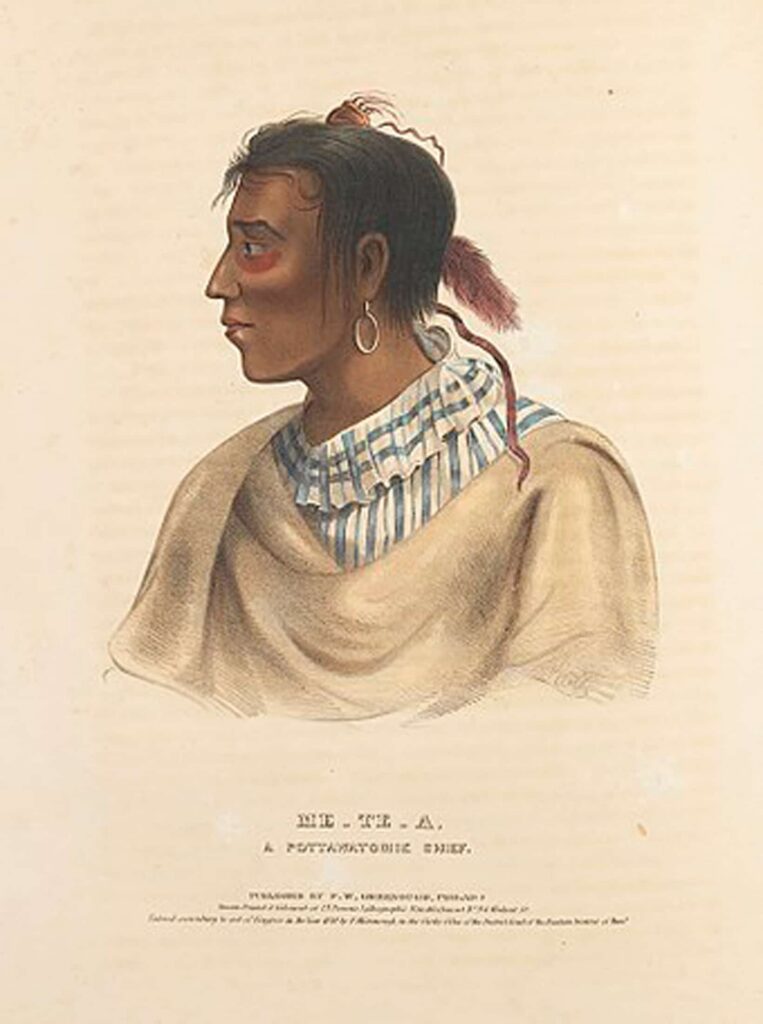
At the 1821 treaty council in Chicago, Potawatomi leader Metea asked U.S. commissioners to consider what another land cession would mean for a people whose dead were already buried there. In the English account of his speech, he said there was “hardly land enough left to cover the bones of our tribe.” Six years later, Metea died in Fort Wayne. Local histories place his burial in the west-end sand hills, in what is now West Central. The exact grave site remains unverified. [1] [2] [3] [4]
A Potawatomi leader at the treaty table
The Citizen Potawatomi Nation’s Cultural Heritage Center identifies Metea’s village as Meskwawasebyéton, near Fort Wayne. He was an ally of the Shawnee leader Tecumseh and fought during the War of 1812. While scouting forces led by William Henry Harrison as they marched toward Fort Wayne, he was shot in the arm. The injury left him with a lasting disability. He went on to speak and sign at treaty negotiations and supported educational opportunities for Potawatomi students at the Choctaw Academy. [1]
At Chicago, U.S. commissioners sought land from the Potawatomi, Odawa, and Ojibwe. Metea warned that each cession left less land for his people to live on and pass to their children. He also spoke of responsibility to earlier generations. His words survive in an English record of an interpreted speech, an important part of how the account reached us. [2] [5]
A death in Fort Wayne
The accounts agree that Metea died in 1827 and differ on the month and circumstances. The 1889 Valley of the Upper Maumee River gives May and repeats a suspicion that he was poisoned because of his position on an 1826 treaty. A later account drawing on Thomas McKenney gives October and describes an accidental ingestion of nitric acid. The conflicting accounts leave the cause of death uncertain. [1] [3] [5]
The west-end sand hills
The 1889 history places Metea’s grave on a sand hill near the site of Fort Wayne College. The college was established in 1846, so it is a later landmark used to describe the area. Another local account places the burial near the west end of Berry Street. A later account describes the vicinity of the St. Marys River between Wayne and Berry streets. Together they point toward West Central. They provide no verified location for the grave. [3] [4] [5] [6]
In his 1917 history, B. J. Griswold says Louis Peltier made Metea’s coffin. Griswold also preserves John W. Dawson’s account that Dr. Lewis G. Thompson had the body taken from the grave to examine it. According to Dawson, the party fled when startled by a noise, then returned and reburied Metea. The story comes through later local history, and the records reviewed here give no confirmed location for that reburial. [7]
Other records describe Indigenous burials on Fort Wayne’s west side. The 1889 history called the west-end sand hills a major burial area. A federal repatriation notice documents funerary objects removed from a West Washington grave. Neither the museum record nor the burial traditions establish that the objects came from Metea’s grave. His speech at Chicago survives in far greater detail than the record of where he was buried. In it, the graves of his people were among the reasons he gave for holding on to their land. [2] [3] [8] [9]
Sources
- Citizen Potawatomi Nation Cultural Heritage Center, Metea
- The 1821 Treaty of Chicago, with extracts from the treaty council
- Valley of the Upper Maumee River, vol. 1 (1889)
- Pokagon–Kekionga Trails, Metea Trail
- Friends of Metea, historical account and references
- Indiana United Methodist Church, Fort Wayne College historical marker
- B. J. Griswold, Pictorial History of Fort Wayne (1917), p. 225, excerpted by Allen INGenWeb
- Federal Register, June 2, 2017, repatriation notice
- Allen County Genealogical Society of Indiana, Indian Burial Grounds of Allen County