
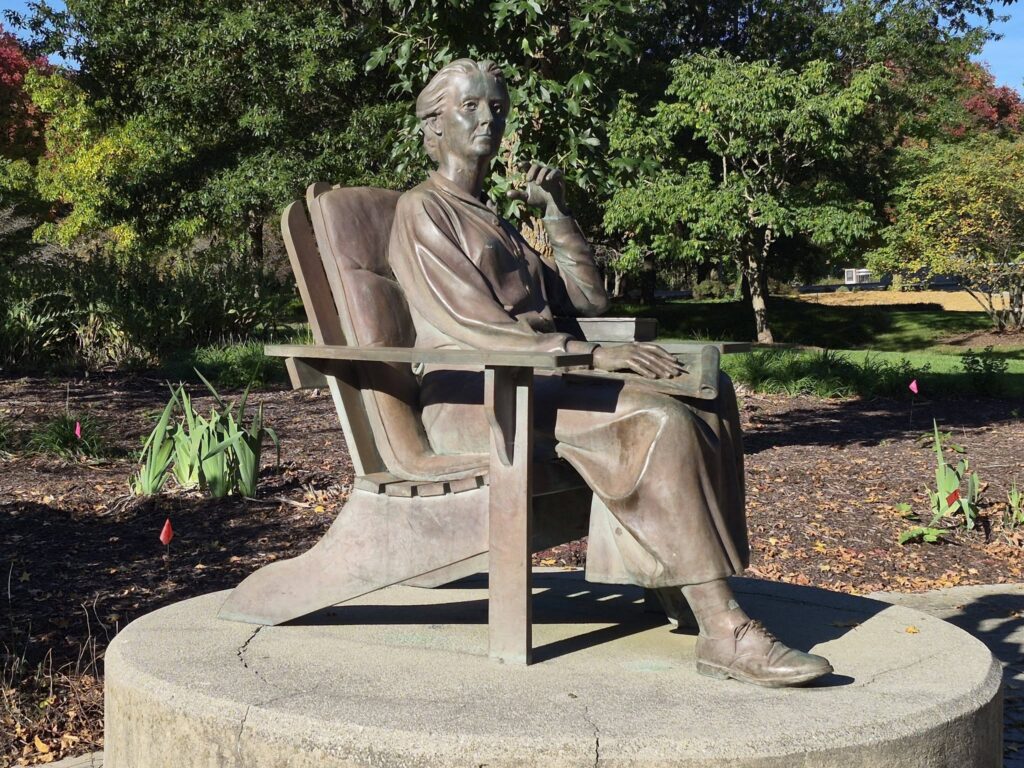
Born in Germany and raised in Fort Wayne, Edith Hamilton became one of the most widely read interpreters of Greek and Roman literature in the English-speaking world. Her path from the Hamilton family homestead to an honorary citizenship in Athens began with a lifelong habit of reading deeply and asking what the ancient writers still had to say.
In the summer of 1957, Edith Hamilton stood before a crowd at the ancient Odeon of Herodes Atticus, beneath the Acropolis in Athens. A performance of her translation of Aeschylus’s Prometheus Bound had brought her to Greece. At the end of the evening, she received a scroll naming her an honorary citizen of Athens. She called it the proudest moment of her life.
Hamilton was nearly ninety. The honor recognized a writer whose books had helped generations of readers meet the Greek and Roman world—not in a distant classroom, but through vivid stories, ideas, and characters. Yet the author celebrated in Athens had spent much of her early life far from the Mediterranean, in Fort Wayne, Indiana.
A Hamilton childhood in Fort Wayne
Edith Hamilton was born in Dresden, Germany, on August 12, 1867, while her parents were living abroad. Her father, Montgomery Hamilton, was the son of Allen Hamilton, the Irish immigrant and early Fort Wayne leader. The family returned to the United States when Edith was an infant, and she grew up on the Hamilton family’s downtown Fort Wayne estate.
Edith was the eldest of four Hamilton sisters. Alice, who became a pioneering physician in industrial medicine, was two years younger. The sisters and their cousins grew up in a close family circle, surrounded by books and encouraged to read widely. Their parents educated them at home, with tutors and independent study, before Edith attended Miss Porter’s School in Farmington, Connecticut.
In 1884, Hamilton entered Bryn Mawr College, where she studied Greek and Latin. She graduated in 1894 and received the college’s European fellowship, which allowed her to continue her studies in Germany. Like many women of her generation, she encountered universities that did not welcome women as full participants. She attended classes in Leipzig and Munich, where women could sometimes sit in lectures only as silent observers.
Teaching in Baltimore
Hamilton returned to the United States and, in 1896, became the first headmistress of the Bryn Mawr School in Baltimore. The school was created to offer girls a serious college-preparatory education at a time when many people doubted that women needed or could manage rigorous academic study. Hamilton expected a great deal from her students. She helped establish a demanding curriculum and a school culture centered on intellectual discipline.
She led the school for more than twenty-five years, retiring in 1922. Hamilton later admitted that she had not especially enjoyed the administrative work. What she loved was literature: reading it, talking about it, and sharing the questions it raised. Retirement gave her the time to pursue that work on her own terms.
Making the classics speak to modern readers
Hamilton’s first major book, The Greek Way, appeared in 1930. She was in her sixties. Rather than write a technical reference work, she invited general readers to encounter ancient Greek writers as living minds—people concerned with beauty, courage, justice, freedom, suffering, and the nature of human life. The Roman Way followed in 1932, and Mythology, her best-known book, in 1942.
Hamilton was not a university professor or an archaeologist presenting new excavations. Her gift was interpretation. She chose passages, translated or retold them in clear English, and showed readers how ancient literature could illuminate the present. Some academic classicists questioned her translations and interpretations, and Hamilton did not claim to be a research scholar. Her reach, however, was extraordinary: she introduced millions of readers to stories and texts that might otherwise have seemed remote or intimidating.
Her later books included The Prophets of Israel and The Echo of Greece. She kept writing and speaking well into old age. In 1957, the same year she was honored in Athens, The Echo of Greece brought her reflections on Greek history and thought to another generation of readers.
From Fort Wayne to Athens—and back into local memory
Hamilton died in Washington, D.C., on May 31, 1963, at the age of ninety-five. Her books remained in print, shaping how students and general readers approached mythology and classical literature. In Fort Wayne, her story is remembered alongside those of her sisters Alice and Norah and the wider Hamilton family. Statues of Edith, Alice, and their cousin Agnes in Headwaters Park offer a public reminder of the paths the Hamilton women took into education, medicine, art, and social reform.
Edith Hamilton’s life began in a household where reading was part of daily life. From that beginning, she became a teacher, school leader, and writer who carried ancient literature into homes and classrooms around the world. Her story links Fort Wayne to a much larger intellectual world—and shows how a local family’s devotion to education could leave a mark far beyond the city.
Sources and further reading
- American National Biography, Oxford University Press, “Edith Hamilton (12 August 1867–31 May 1963).”
- Bryn Mawr College, “Notable Alumnae of the Classics Department: Edith Hamilton.”
- The History Center, “The Extraordinary Hamilton Women.”
- Catherine E. Forrest Weber, “A Citizen of Athens,” Traces, Winter 2002.
- Bryn Mawr School Archives, “Who Was Edith Hamilton?”
- Edith Hamilton, The Greek Way (New York: W. W. Norton, 1930); The Roman Way (New York: W. W. Norton, 1932); and Mythology (Boston: Little, Brown, 1942).