
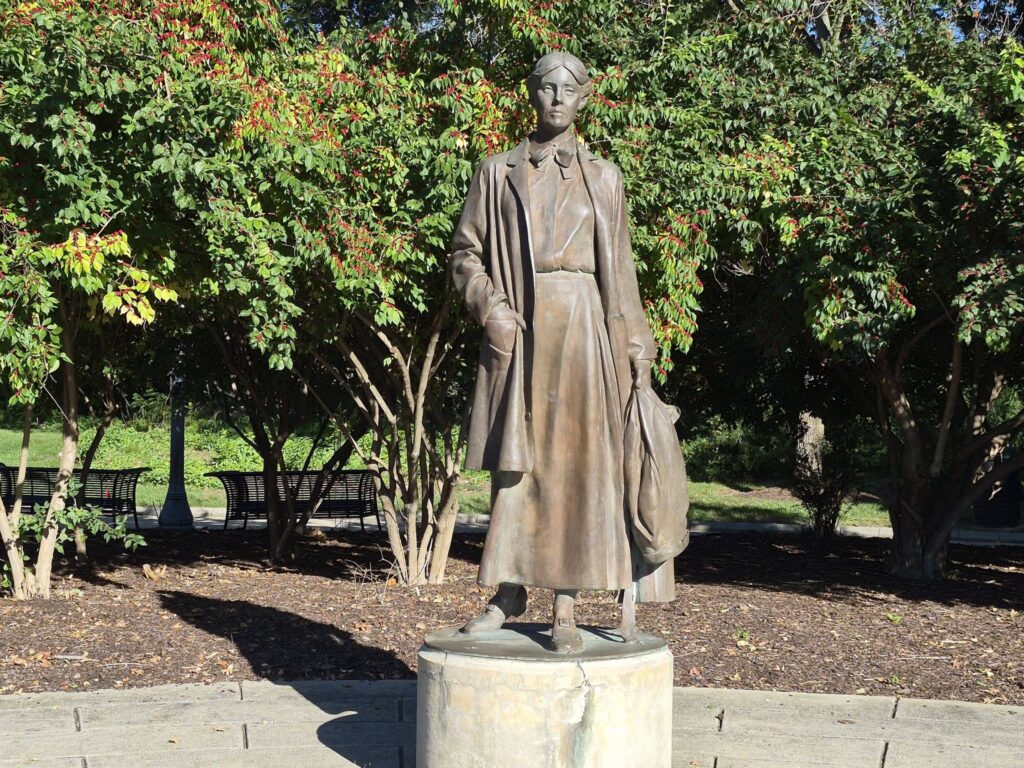
Born in New York but raised in Fort Wayne, Alice Hamilton became one of America’s most important investigators of industrial disease. Her work brought the hazards of dangerous trades into public view—and helped change how the nation thought about workers’ health.
In 1919, when Harvard Medical School appointed Dr. Alice Hamilton to its faculty, the university made history. Hamilton was its first woman faculty member. The milestone came with a set of exclusions: she could not join the Faculty Club, march in the commencement procession, or receive faculty football tickets. She had earned a place at one of the country’s most powerful institutions, but its traditions still treated her as an outsider.
Hamilton had grown up in Fort Wayne, in a family whose name was already woven into the city’s story. Her grandfather was Allen Hamilton, the Irish immigrant and early civic leader whose life helped shape the young town. Alice’s own influence reached far beyond Fort Wayne. Through medicine, painstaking research, and public advocacy, she helped reveal the human cost of industrial production.
A Fort Wayne education—and a different ambition
Alice Hamilton was born in New York City on February 27, 1869, while her family was away from Indiana. She was raised in Fort Wayne as the second of four sisters. Their childhood centered on the large Hamilton family property, a place of close-knit households, books, and family traditions. Her older sister Edith would later become celebrated for her books on Greek mythology and classical literature.
The Hamilton girls were mostly educated at home. Alice later recalled that her parents emphasized languages and literature more than mathematics and science. After attending Miss Porter’s School in Connecticut, she decided to become a doctor. To prepare, she studied physics and chemistry with a Fort Wayne high-school teacher and took biology and anatomy courses locally. In 1892 she entered the University of Michigan’s medical department, graduating with her medical degree the next year.
Medical training opened doors, but Hamilton was not content simply to practice medicine in a private office. After hospital internships, she traveled to Germany to study bacteriology and pathology, fields that were then expanding rapidly. Women faced barriers even in the classroom: at times she and Edith could attend university lectures only on the condition that they remain “invisible” to male students. In 1897, Alice returned to the United States and accepted a teaching position in Chicago.
At Hull House, illness had a workplace
Chicago brought Hamilton into a world very different from the sheltered family compound in Fort Wayne. She lived at Hull House, the settlement founded by Jane Addams and Ellen Gates Starr, where reformers and working-class immigrant neighbors shared a community. Hamilton treated patients and helped run a well-baby clinic. As she listened to families, she heard about recurring illness, unexplained deaths, and workers whose hands or wrists had become weak or paralyzed.
She began to ask a question that was not yet receiving enough attention in the United States: could a person’s job be making them sick? Hamilton learned about the trades themselves, visited workplaces, spoke with workers and employers, and studied the chemicals used in production. She combined close observation with laboratory methods. The approach made her one of the earliest American physicians to devote her career to industrial medicine.
Lead poisoning became one of her central concerns. Hamilton investigated the lead industries and other workplaces where chemicals harmed workers, including enamelware, paint, rubber, and explosives production. She also studied carbon monoxide poisoning among steelworkers, mercury poisoning among hat makers, and the “dead fingers” that afflicted laborers using jackhammers. Her findings connected symptoms seen in clinics and homes to specific industrial processes—and made it harder for employers and officials to dismiss those illnesses as personal misfortune.
Taking the evidence into public life
In 1908 Hamilton published an early article on occupational disease in the United States. In 1910 Illinois appointed her to its Occupational Diseases Commission, the first government body of its kind in the country. She led investigations that helped bring industrial poisoning into state policy discussions and contributed to new worker protections. Later she carried out studies for federal agencies, examining dangerous trades across the country.
Harvard’s offer in 1919 recognized the importance of that work. Hamilton taught industrial medicine while continuing field research, and she accepted the job on terms that let her keep investigating workplaces. She served on the League of Nations Health Committee from 1924 to 1930, the only woman on the committee. Her research and writing helped establish industrial toxicology as a serious area of public-health study.
Hamilton retired from Harvard in 1935 but did not retire from the issue. She continued as a consultant to the U.S. Division of Labor Standards and remained active in reform work. In her 1943 autobiography, Exploring the Dangerous Trades, she described the investigations that had taken her into factories and mines, where scientific evidence and workers’ experiences met.
A Fort Wayne legacy with national reach
Alice Hamilton lived to be 101, dying on September 22, 1970. Her career stretched from a childhood in Fort Wayne to research that influenced public health across the United States and abroad. She did not work alone: Hull House colleagues, fellow scientists, workers, and reformers all contributed to the movement for safer workplaces. Hamilton’s particular contribution was to bring the doctor’s eye, the investigator’s persistence, and the reformer’s sense of responsibility to a field that industry had often preferred to ignore.
Fort Wayne remembers Hamilton alongside her sisters and cousins as part of the remarkable Hamilton family. But her story is more than a family legacy. It is a reminder that a city’s history can send people outward into the world—and that someone raised among privilege can choose to spend her life listening to people whose labor and illness were often overlooked. Alice Hamilton carried her Fort Wayne beginnings into a career that helped workers make the case that their health mattered.
Sources and further reading
- U.S. National Park Service, “Dr. Alice Hamilton.”
- U.S. National Library of Medicine, “Biography: Dr. Alice Hamilton.”
- American Chemical Society, “Alice Hamilton and the Development of Occupational Medicine.”
- Harvard University, Office of the Senior Vice Provost for Faculty, “First Female Faculty at Harvard: Dr. Alice Hamilton.”
- The History Center, “The Extraordinary Hamilton Women.”
- Alice Hamilton, Exploring the Dangerous Trades: The Autobiography of Alice Hamilton, M.D. (Boston: Little, Brown, 1943).