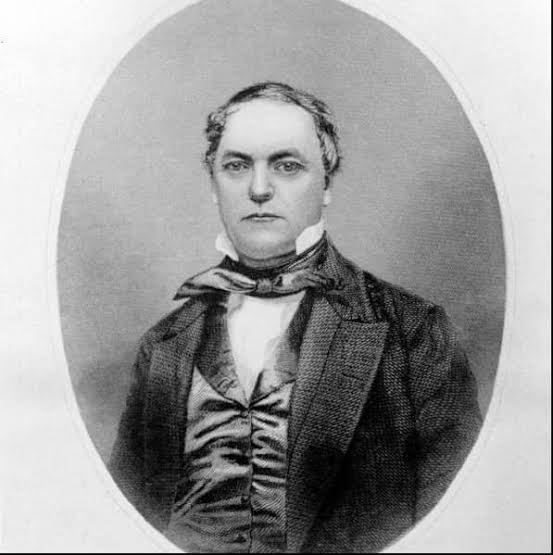
From a young Irish immigrant to a leading merchant, banker, and public official, Allen Hamilton helped shape Fort Wayne during its first decades. His story also reveals the unequal terms on which the city’s growth unfolded.
When people talk about the founders of Fort Wayne, Samuel Hanna’s name often comes first. Another name belongs beside his: Allen Hamilton. Hamilton arrived in the young settlement in 1823, when Fort Wayne was still a small frontier community at the meeting of the St. Marys, St. Joseph, and Maumee rivers. He would become one of its most influential merchants and public men—and a figure whose career was tied to both the city’s growth and the dispossession of the Miami people.
An Irish newcomer on the frontier
Hamilton was born in Ireland in 1798 and came to the United States as a young man. After settling first in southern Indiana, he moved with his family to Fort Wayne in 1823. The Indiana Historical Society’s guide to his family papers identifies him as an early founder of the town and records his appointment as deputy clerk in the United States Land Office. That position put him close to the machinery of a fast-changing frontier: land claims, government business, trade, and the arrival of new settlers.
Hamilton quickly entered public life. He served as Allen County sheriff from 1824 to 1826, postmaster from 1825 to 1831, and county auditor, clerk, and recorder through much of the 1830s. These jobs were not distant titles. In a small county, they placed Hamilton at the center of daily civic life, where public records, mail, law enforcement, and local government were still taking shape.
Trade, land, and a growing town
Hamilton also understood that Fort Wayne’s location was an opportunity. The Three Rivers connected routes that reached far beyond the settlement, and the long portage between the Maumee and Wabash watersheds had long been important to Native trade and travel. In partnership with Cyrus Taber, Hamilton established the firm of Hamilton and Taber in the 1820s. The business engaged in trade with Native communities, especially the Miami, and helped Hamilton build a network of relationships and influence.
As his resources grew, Hamilton invested in land and local businesses. He was involved in milling and mercantile ventures, and in 1835 became the first president of the Fort Wayne branch of the State Bank of Indiana. Banking helped merchants and residents conduct business in a region where cash was scarce and credit could determine whether a new enterprise survived. Hamilton later led the Allen Hamilton National Bank, whose name kept his place in local finance visible long after his death.
Fort Wayne’s rise was not the work of one person. Its position at the rivers, the Wabash and Erie Canal, migration, commerce, and the labor of many communities all mattered. Hamilton was among the people who connected local opportunity to state and federal power. He served on commissions negotiating treaties with the Miami in 1834 and 1838, on a commission dealing with Native land titles in Indiana in 1840, and as U.S. Indian agent to the Miami from 1841 to 1845.
A complicated legacy
Those appointments point to a difficult truth about the region’s development. The land on which Fort Wayne expanded was not an empty frontier. It was the homeland of the Miami people, whose political authority and property were steadily undermined through treaties, federal policy, and settler pressure. Hamilton worked within that system, sometimes as a negotiator and government agent, and also as a trader and adviser to Miami leaders.
His relationship with Chief Jean Baptiste de Richardville makes that history especially personal. Hamilton served as Richardville’s financial and legal adviser and, after the chief’s death in 1841, as executor of his estate and guardian of his children. The History Center’s account of Hamilton’s records states that the estate’s wealth was depleted under Hamilton’s management, leaving Richardville’s family with virtually nothing. The surviving executor’s account book is part of the historical society’s collections. It offers a reminder that a successful career in Fort Wayne’s early economy could also carry profound consequences for Native families.
We should hold both parts of Hamilton’s story in view. He helped establish institutions that served a growing town, and he gained influence by navigating a political and commercial order that transferred Native land and wealth to newcomers. Remembering him as a founder does not require smoothing over that imbalance; it gives us a more honest account of what “building” the city involved.
Public service and family
Hamilton continued his public and business work into later life. In 1851 he took part in Indiana’s constitutional convention as a Whig delegate, and in 1859 he was elected to the Indiana Senate. He remained active in banking until his death in 1864. His wife, Emerine Jane Holman Hamilton, and their children became part of a family whose civic, educational, artistic, and reform work would shape Fort Wayne for generations.
Today the Hamilton name appears in the city’s streets, institutions, archives, and family history. It recalls a man who helped organize a frontier county and build its commercial life, but it also opens a door onto the Native history that conventional founder stories often leave at the margins. Allen Hamilton’s life is a reminder that Fort Wayne’s early growth was ambitious, interconnected, and deeply unequal.
Sources and further reading
- Indiana Historical Society, Allen Hamilton Family and Legal Papers, 1814–1924: Collection Guide.
- The History Center, “Allen Hamilton and Taber Hamilton Collection”.
- Tom Castaldi, The History Center, “The Extraordinary Hamilton Family”, May 2013.
- Allyn C. Wetmore, Allen Hamilton: The Evolution of a Frontier Capitalist (Ph.D. dissertation, Ball State University, 1974).
- Wallace A. Brice, History of Fort Wayne, from the Earliest Known Accounts of This Point, to the Present Period (Fort Wayne: D. W. Jones and Son, 1868), biographical sketch of Allen Hamilton.