
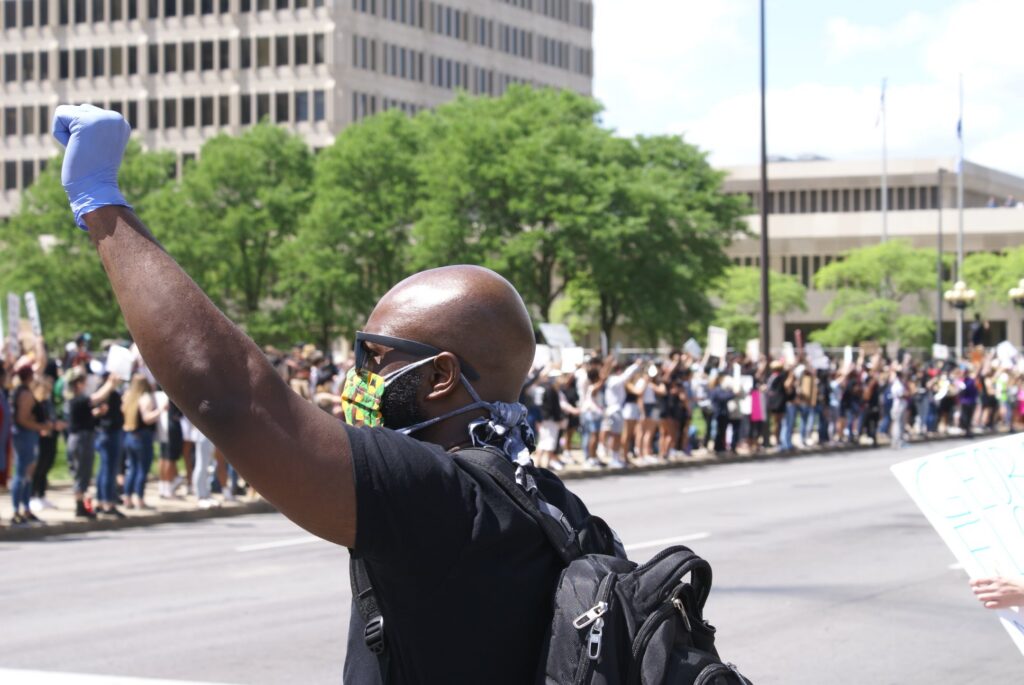
On May 29, 2020, four days after George Floyd was killed by a Minneapolis police officer, Fort Wayne residents gathered at the Allen County Courthouse to protest racial injustice and police brutality. The demonstrations continued through the weekend and prompted a citywide debate about protest, policing, and accountability.[1] [2]
The first major downtown demonstration described in contemporaneous reports took place on Friday, May 29. Organizer Alisha Rauch called people to the Courthouse Green. By late afternoon, several hundred people had gathered near South Clinton Street. Many wore masks, carried handmade signs, and chanted “Black Lives Matter” and “No Justice, No Peace.” Drivers slowed, honked, and raised their hands in support as the demonstration continued along the courthouse sidewalks.[1] [2]
From the Courthouse Green to Clinton Street
For the first hours, the gathering remained largely on the sidewalks. As the crowd grew, some demonstrators moved into the roadway and toward the Martin Luther King Jr. Bridge, filling the intersection of Clinton and Main. By about 8 p.m., police in riot gear had moved into the area and deployed tear gas and pepper spray. Local reporting recorded different accounts of whether officers’ dispersal warnings could be heard: police said warnings had been given, while protesters said they did not hear them before chemical agents were used.[1] [2]
The evening also included isolated acts of property damage. WBOI reported that some people broke downtown windows as the confrontation unfolded, while many others continued to chant, assist people affected by tear gas, or urge the crowd to remain peaceful. Fort Wayne Police reported 29 arrests Friday night; the clashes continued into early Saturday.[1]
A second day of demonstrations
People returned to the Courthouse Green on Saturday, May 30. Speakers called for racial justice and continued demonstrations. Members of the 10 Point Coalition helped direct traffic as protesters gathered near Clinton and Main. Later, police again formed lines and used tear gas as the crowd occupied parts of the roadway. WBOI and WFYI reported that protests and clashes continued into Saturday evening. WFYI reported that nearly 70 people were arrested Saturday and that one officer was taken to the hospital with a non-life-threatening injury. Demonstrator Balin Brake suffered a severe eye injury after being struck by a tear-gas canister fired by police. The record of those events includes sharply different accounts from law enforcement and protesters, which later became part of civil litigation.[1] [5] [7]
Watch footage from the demonstrations
The following video is embedded using the link provided for this post:
Protest, prayer, and calls for change
The weekend was not defined only by confrontation. On Sunday evening, hundreds attended an interfaith prayer and peace vigil at Lutheran Park, organized in the wake of Saturday’s events. Protesters returned to the Courthouse Green, and in the days that followed community members continued to gather and speak publicly about racism and police accountability.[1]
On June 4, city officials and community members joined protesters for a unity march from the Courthouse Green to the Martin Luther King Jr. Bridge. Mayor Tom Henry, Police Chief Steve Reed, and Allen County Sheriff David Gladieux linked arms with marchers. Organizers also collected signatures on demands for local law-enforcement reforms. WBOI described it as the fourth consecutive protest without an arrest or incident, while marchers emphasized that public dialogue and further change still had to follow.[3]
On June 18, Mayor Henry announced the “Moving Forward Together” action plan and created a Mayor’s Commission on Police Reform and Racial Justice. The commission’s executive summary grouped recommendations under race relations, communication, and departmental transparency, describing community dialogue and trust as central to its work.[4]
How the events were remembered
In June 2020, the ACLU of Indiana filed suit on behalf of protesters, alleging that police use of tear gas, pepper spray, rubber bullets, and other force violated their rights. Those claims were allegations in litigation, not a court finding of liability. The City of Fort Wayne and the ACLU later published agreed principles for protest activity on public property; the document expressly stated that the agreement was not an admission of liability or wrongdoing by the City or police.[5] [6]
Contemporaneous reporting, community testimony, legal records, and video all preserve different pieces of a difficult local history. Remembering Fort Wayne’s 2020 protests means keeping those records in view together: the reasons people came to the Courthouse Green, the experiences of those who demonstrated, the damage and injuries that followed, and the citywide calls for justice, dialogue, and reform.
Works Cited
- Abbott, Ella. “A Weekend of Protests in Fort Wayne.” WBOI, June 1, 2020.
- Green, Rebecca, and Ella Abbott. “Police and Protesters Square Off in Fort Wayne.” WFYI, May 30, 2020.
- Abbott, Ella. “Fort Wayne Unity March, Protests Remain Peaceful Into Friday.” WBOI, June 5, 2020.
- City of Fort Wayne. “Moving Forward Together: Action Plan to Address Public Safety and Racial Justice — Executive Summary.” June 2020.
- ACLU of Indiana. “ACLU of Indiana Sues Fort Wayne for Use of Chemical Weapons on Protesters.” June 26, 2020.
- City of Fort Wayne and ACLU of Indiana. “Memorialization of Agreed Principles Concerning Protest Activity in Public Places in Fort Wayne, Indiana.” 2021.
- WFYI. “Peaceful Protests Followed by Police Clashes Take Place Across Indiana Over Weekend.” June 1, 2020.