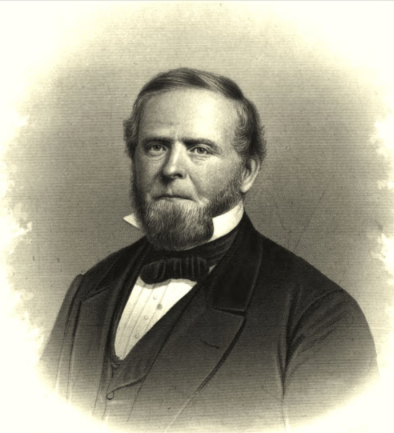
When Samuel Hanna arrived in Fort Wayne in 1819, the place was a small trading settlement. By the time he died in 1866, it had become a growing city connected to distant markets by canal and railroad. Few people had participated more persistently in that transformation.
Merchant, judge, legislator, banker, landowner, and railroad executive, Hanna helped supply the money, organization, and determination behind many of Fort Wayne’s early improvements. His story helps explain how the city grew—and how closely public development and private enterprise were intertwined.
From Kentucky to the Three Rivers
Samuel Hanna was born in Scott County, Kentucky, on October 18, 1797. His family moved to the Dayton, Ohio, area in 1804. His early work included helping on the family farm, delivering newspapers through the countryside, clerking in a store, and teaching school.
One early experience became a favorite illustration of his character. According to G. W. Wood’s biography, Hanna and a young business partner purchased a store’s stock on credit, only to lose the goods through an attachment. Although Hanna could have contested his liability because he was underage, Wood reports that he eventually paid the debt, including interest. The story introduces the quality that runs throughout the book: a reputation for meeting obligations even when doing so was difficult. [1]
In 1818, Hanna and his brother Thomas supplied food and horse feed at the treaty gathering at St. Marys, Ohio. The venture provided him with some capital. The following year, he moved to Fort Wayne and opened a small store at what became the northwest corner of Columbia and Barr streets. Wood describes a log building, erected largely through Hanna’s own labor, that was later replaced by more substantial structures. [1]
The region already had a history of Indigenous settlement and trade. Native customers were central to Hanna’s early business, and he subsequently became an agent of the American Fur Company. His arrival therefore marks a chapter in Fort Wayne’s development, not the beginning of the community’s history. [2]
Opening a route to wider markets
Hanna understood a practical problem facing the young settlement: growth depended on transportation. Supplies were expensive and difficult to bring in, while farmers and merchants needed better ways to move goods out. Wood describes the exhausting work of hauling freight through mud and navigating rivers obstructed by fallen timber. [2]
The Wabash and Erie Canal offered a way to connect the region to larger markets. Hanna worked closely with David Burr to promote the project, win political support, and advance the preliminary surveys. Wood credits Hanna with purchasing surveying instruments in New York and bringing them back by way of Detroit, with the final overland journey made on horseback. [3]
His involvement extended beyond advocacy. Hanna served as a canal commissioner and fund commissioner, represented the region in the Indiana legislature, and helped secure financing. Wood also describes him working with an ax during the survey of the canal’s summit feeder. The portrait is of a promoter willing to take part in the physical work as well as the negotiations. [3]
The canal’s opening to the lake in 1843 brought an improved outlet for produce and a route for incoming people and goods. For Fort Wayne, transportation was becoming a foundation for commercial expansion. [4]
Banking and the growing town
Hanna’s work in finance was another important part of that expansion. Wood credits him with a leading role in drafting the charter for the State Bank of Indiana, approved on January 28, 1834. Hanna later served as president of its Fort Wayne branch for much of its existence, while Hugh McCulloch served as cashier. [4]
He was also a major land investor. In 1836, he purchased the remaining Barr and McCorkle land interests adjoining and surrounding the town plat, then began laying out and selling lots. The purchase eventually became profitable, but Wood explains that slow sales and overdue payments initially placed Hanna under considerable financial strain. [4]
Wood praises his patience toward buyers who struggled to pay. That account forms part of the biography’s larger celebration of Hanna’s generosity; it also reveals how closely his fortune was tied to the town’s success. As Fort Wayne grew, the value of his investments grew with it.
From wooden roads to iron rails
The canal did not solve every transportation problem. Roads leading into Fort Wayne remained difficult to travel, especially in bad weather. Hanna helped organize the Fort Wayne and Lima Plank-road Company and took responsibility for the first ten miles north of town. Wood describes him supervising and physically assisting with construction. He also participated in the Piqua plank-road project. [5]
Railroads soon offered a more powerful connection to regional and national commerce. In 1852, Hanna joined Pliny Hoagland and William Mitchell in the contract to build the Ohio and Indiana Railroad between Crestline and Fort Wayne. When money ran short, he helped obtain financing and recover iron needed to continue construction. Trains reached Fort Wayne over the line in November 1854. [5]
Hanna also became president of the Fort Wayne and Chicago Railroad Company. He supported the consolidation that created the Pittsburgh, Fort Wayne and Chicago Railway Company on August 1, 1856, and became its vice-president. These efforts helped place Fort Wayne on a major east–west rail route. [5]
For the city, the significance went beyond trains passing through. Hanna pressed to locate railroad repair shops and manufacturing facilities in Fort Wayne. Wood identifies that campaign as one of his most important services to the community. The shops brought work and industrial activity into the city, making the railroad a local employer as well as a transportation link. [6]
A stake in the community
Hanna invested in manufacturing ventures beyond the railroad, including a woolen factory, a foundry and machine-shop enterprise, and a hub, spoke, and bending factory. He supported the organization of First Presbyterian Church in 1831, became a member in 1843, and subsequently served as a ruling elder. [7]
He remained engaged in new projects near the end of his life, accepting the presidency of the Grand Rapids and Indiana Railway Company shortly before his death. After a brief illness, he died on June 11, 1866. City officials arranged to attend his funeral together, and businesses were asked to close during the observances. Wood describes a funeral procession stretching from the courthouse toward Lindenwood Cemetery. [7]
The city as his monument
Hanna was one of several people whose ambitions, investments, and work helped shape nineteenth-century Fort Wayne. His importance lies in the range and persistence of his involvement. Across successive technologies—from river transport and canal boats to plank roads and locomotives—he continued looking for ways to connect the city to a larger economy.
At the public meeting held after Hanna’s death, Joseph K. Edgerton suggested that Fort Wayne itself was his most lasting monument. That remains a useful way to understand his legacy: through the commercial connections, industrial enterprises, and expanding neighborhoods he helped make possible. [8]
Sources & reading notes
This article is based primarily on G. W. Wood’s 1869 memorial biography. Written to honor Hanna after his death, it offers valuable accounts of his business and civic work, but its praise and its descriptions of Indigenous people reflect the author’s perspective and period. The article treats those judgments as historical testimony rather than adopting them as neutral fact. References above use the book’s printed page numbers, not the PDF viewer’s page count.
- G. W. Wood, The Life and Character of Hon. Samuel Hanna (Fort Wayne, Ind.: T. S. Taylor & Co., 1869), pp. 5–9. Early life, store debt, St. Marys venture, and arrival in Fort Wayne.
- Wood, pp. 9–15. Early trade, American Fur Company agency, and transportation difficulties.
- Wood, pp. 16–19. Canal advocacy, surveying, legislative service, and financing.
- Wood, pp. 19–22. State Bank charter, Fort Wayne branch, land purchase, and the canal connection to the lake.
- Wood, pp. 23–30. Plank roads, railroad construction, arrival of trains in 1854, and consolidation.
- Wood, pp. 31–32; see also Joseph K. Edgerton’s memorial address reproduced in Wood, pp. 33–40. Railroad shops and local interests.
- Wood, pp. 44–48. Grand Rapids and Indiana Railway presidency, manufacturing investments, church involvement, death, and funeral.
- Edgerton’s memorial address, reproduced in Wood, pp. 39–40. Fort Wayne as Hanna’s monument.
For further research, explore the Hanna Family Album in the Allen County Public Library’s digital collections: